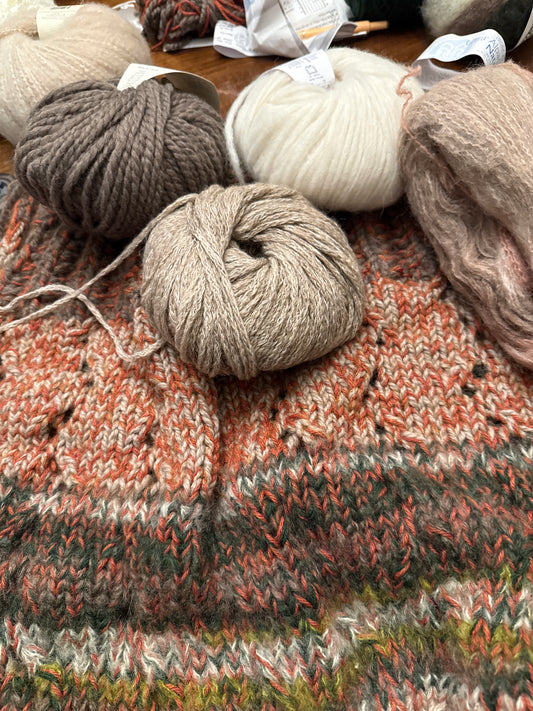

I love doing short rows. They are fun, intriguing, and honestly a little bit magical, especially when it comes to shaping garments. Now, figuring out the proper math formula behind them may not always be easy, but that is a whole blog, so I am not going there today.
What I want to talk about is why I love short rows.
Short rows are such an important part of knitting because they create shaping exactly where we need it. One of the most practical places we see them is in the back neck area of a garment. That extra bit of fabric helps compensate for the natural curve of our backs, so the sweater does not ride up in the front and the back does not end up shorter than it should be. It is one of those little design details that makes a big difference in how a garment fits and feels when you wear it.
But short rows are not just practical, they are beautiful in design too.
They can create shape changes, texture, movement, and wonderful visual interest. They can take a simple project and make it far more intriguing. For instance, the Butterfly Cowl uses short rows in such a lovely way, working a solid color yarn alongside a self-striping yarn. The effect is eye-catching and gives the piece a special kind of movement. Then there is the Floatini, a shawl I just love, using Emma’s Yarn and alternating mohair with slub yarn. Short rows in a project like that create such a pretty rhythm and flow in the fabric.
There are also several short row techniques, and each one has its place. Some patterns use Wrap & Turn, which works especially well in garter stitch. I personally love the German Short Row, sometimes called the DS or double stitch method. It is clean, clever, and one I enjoy using often. I also really like the Japanese Short Row technique. It takes a little more attention, but you all know me. I am always up for a challenge.
What makes short rows so wonderful is that they can be used in both structural shaping and decorative design.
For fit engineering, short rows can create:
- Back neck shaping to keep sweaters from pulling forward
- Shoulder slope shaping to better mirror the natural angle of the shoulders
- Bust darts to add room where needed without changing the side seams
-
High-low hems for a longer back without altering the overall stitch count
And then there is the creative side of short rows, which may be my favorite part. They are not just structural; they are graphic too. They can be used for:
- Wedges in shawls
- Sculpted garter ridges
- Organic color blocking
-
Stripe distortion effects
That is where short rows become especially exciting. They are not only solving a problem, they are adding beauty. They can create curves, angles, movement, and texture in ways that make a project far more interesting to knit and to wear.
I think that is why I keep coming back to them. Short rows are both practical and artistic. They help a garment fit better, but they also open the door to so much creativity. They are one of those techniques that remind us knitting is not just about making fabric—it is about shaping, engineering, and artistry all working together.
And really, what is not to love about that?
 We have a workshop coming up in which we are offering Short Row Techniques.
Hope to see you there. Always more fun to learn with a group of people! I love it and you 😉
Hugs and kisses.
Doris